
understanding genre
and how to subvert it

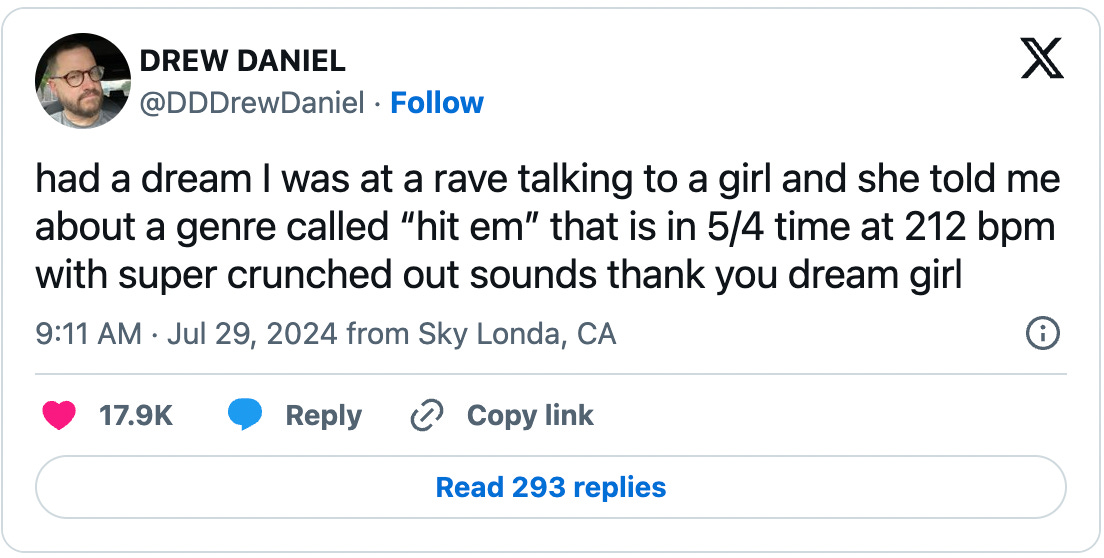
Last summer, Drew Daniel had a dream. In it, he was at a rave where a mysterious girl told him about a new music genre called "Hit Em." She described it as music in 5/4 time at 212 beats per minute, with "super crunched out" sounds.
For those unfamiliar with music jargon, I’ll just tell you: this is a psychotic set of criteria. 5/4 time is an unstable-feeling time signature—the downbeat happens every five beats instead of every four, as in most Western music. It is used occasionally in jazz and math rock, but it makes few appearances in the popular music of the modern era. The palindromic 212 bpm is faster than virtually all music composed today. And, obviously, the mandate of “crunched out” sounds refers to a perceptible level of audio degradation (distortion, saturation, overdrive, downsampling, things like that). As the name suggests, it’s an aural assault on many levels—a profound and profane recipe for a musical composition. The rules are simple but so extreme that the results are all but guaranteed to sound aesthetically unified—though perhaps unpleasant.
Daniel is an experimental musician, one half of the duo Matmos. If you’ve listened to his music, you know that unconventional musical structures are his main mode of expression. His work is full of sonic collisions, found sounds, jittery off-kilter beats, and ambient breakdowns.
He woke up evidently amused by the aesthetic promise of “Hit Em” and told the world about it in a tweet. His following—a group of highly online, eccentric electronic music nerds—immediately got to work literalizing his dream genre. Within a day, experiments in “Hit Em” took over music twitter and proliferated across the internet. These tracks were glitchy, industrial-sounding, and very fast, placing it in the sonic realm of (according to one Reddit user) “Gabber” and “Speedcore.”
It was a fun moment to be a music producer on the internet.
Participation
I was charmed by the brief phenomenon that was “Hit Em” for many reasons: its name reminded me of “riddim,” a subgenre of dubstep and a term more generally used in Jamaican Patois to mean “rhythm” or instrumental track. It also felt like a kind of performative acknowledgment of how ridiculous the taxonomy of microgenres has become. Most importantly, it showed, in warp speed (212 bpm, if you will), how genres are constructed via creative constraints, prevailing technologies, aesthetic taste-making, and community participation.
But it also revealed something deeper: that the creation of "Hit Em"—through collective imagination, a dream, and the playful immediacy of Twitter—was itself a compelling work of art. The tracks produced in the genre, while interesting and chaotic, were secondary to the thrilling energy of the genre’s genesis in that moment. The phenomenon captured and interesting paradox of genre: strict parameters that inspire rapid creative output while also exposing the limitations of what those parameters can produce.
Community Dynamics
For the DIY creative producer, genre should be seen as an instrument in the pursuit of intelligibility, not an end in itself. Genre conventions—like four-on-the-floor kicks in house music or lush reverb and pads in ambient—serve as a shorthand, a kind of contract between the artist and their audience. When you engage with these codes thoughtfully, you’re speaking directly to your listeners, signaling where your music belongs in the greater matrix of audio culture. But what makes music powerful, and what ultimately keeps genres from stagnating, is how artists break those codes and expand their possibilities.
This has been a discussion within literary theory for years. Writing in 1970, Tzvetan Todorov’s The Fantastic examined how genres function as dynamic systems of expectations shaped by artists and audiences. John Frow expanded on this in his 2006 book, Genre, describing genres as social practices—frameworks that organize and interpret cultural texts. In electronic music, these ideas manifest in how genre tags on platforms like SoundCloud or Spotify guide listener expectations and influence the music’s reception. At their best, microgenres like “Hit Em” or “Simpsonwave” or “Hardvapor” offer playgrounds for innovation, where absurdity and experimentation coexist with meaningful community-building.
Legible Music // Good Art
But microgenres, with their hyper-specificity, can also entrench artists in formulas, preventing growth beyond a narrow niche. The primary tension I’m trying to describe is this: while understanding genre is essential to making music that connects with listeners, it’s not sufficient to create good art. Good art demands an artistic agenda—a vision that transcends genre entirely. Without this guiding purpose, you risk making music that is merely intelligible, rather than meaningful.
Returning to “Hit Em,” we see how this tension plays out. The genre's appeal wasn’t in any individual track but in the joyful, surreal act of inventing and defining a genre in real time. The rapid-fire creation embodied the community’s shared imagination, demonstrating how genre, at its best, can be a collaborative and ephemeral art form. But what made it exhilarating also made it impermanent. The strict parameters of "Hit Em" didn't lead to timeless tracks; instead, they served as a vessel for collective play within a specific cultural moment.
My Audit
I, personally, have some ambivalence about genre because it feels reductive to discuss my own work in terms of genre tags. I, like so many of us, balk when asked, “What kind of music do you make?” and the answer is almost never a compelling sell. It’s full of apologetic nods to meaningless descriptors like “Leftfield” or “IDM” or “Deconstructed Club.” Sometimes, instead of that whole charade, I’ll just discuss the tools or the processes used in the making of music: “I like heavy beats, ecstatic synth swells, mangled vocals, and lots of ambient reverb.” Some people know what that means; others stare blankly or seem annoyed that I can’t give them a straight answer. At the same time, to place yourself squarely within a genre, with an agreed-on set of criteria, comes off as a comparison to the most mainstream figures in that world. If I say I make “Art Pop” (which I don’t), I risk sounding like I’m comparing myself to Lady Gaga or something. To compare yourself to a famous artist seems like unrealistic self-flattery. At best, you’re unhelpful; at worst, you’re pretentious.
But, in thinking about musical genre, not just as an aesthetic taxonomy but also as a dynamic interaction between artists and communities, I’m compelled to give genre a bit more attention. Popular arts are modes of communication with the public, meant to channel radical ideas through intelligible frameworks. I want to develop a friendlier relationship to the idea of genre because I think it will help my music communicate with more impact. And—on the matter of a higher artistic purpose— there might be some ways to incorporate genre as a social phenomenon into my personal artistic narrative. This week, I’m doing an audit of the music genres that have influenced my practice both aesthetically and socially. I’m thinking about questions like, “How did the punk scene of my middle school years inform the ways I think about sociality and masculinity?” or “How did my participation in the Brooklyn Chillwave scene in the 2010s expand my conception of what ‘pop’ means?” or “What exactly is ‘dance music,’ and do I like it because I like to dance to it, or because of what I think it says about me and my taste?” The answers to these questions are things to explore and incorporate into my broader artistic agenda. This is an exercise I would suggest to anyone who might be suspicious of genre as too facile a categorization of their work.
As producers, it’s critical to engage with genre as a tool to understand and connect with audiences. But to make music that truly resonates, consider going a bit deeper. What is your artistic agenda? What are you trying to express, build, or explore that can’t be reduced to a genre tag? By holding these questions at the core of your creative practice, you can move beyond merely making intelligible music and toward making art that matters.
Thanks for reading.